Mistakes made in remote areas can expose themselves quickly. Forgetting a familiar medicine, packing the wrong glasses, or a comfort item that won't work in damp conditions can affect your sleep, your judgment, and how you perform on your hunt. Yet, you wouldn't pack everything you think you'll need for a successful hunt. Rather, you'd determine what you cannot replace and what you need to maintain to be able to function optimally. The remainder will be supplied by the remote lodge.
Start with the failure you are trying to prevent
Start with a simple question such as: What problem will be hardest to fix when we're no longer near? I mentioned above that for one hunter it's his prescribed meds that cannot be refilled quickly enough. For another, it may be their contact lenses, recurrent stomach problems, or the fact that poor sleep from cold and a foreign environment affect his judgment for tracking game.
Write down for yourself all of the failure points for yourself that you can think of for your hunt before picking out a bag and containers for your medicines. Include for this list all of the routine items that you normally would take with you and would need should you have an accident or should you be unable to complete your hunt. Forgotten items such as migraine medicine, or contact lenses and solution, nose decongestant, extra reading glasses, sore feet and blisters and many more all can impact your hunt greatly and must be considered in your packing for your hunt.
See what the lodge has for first aid, bath items, bed clothes, towels, water treatments, etc. Some of these items will be supplied by the lodge and others will be intended to be used occasionally and thus would not be wise to bring.
Build a medicine plan that survives a delayed return
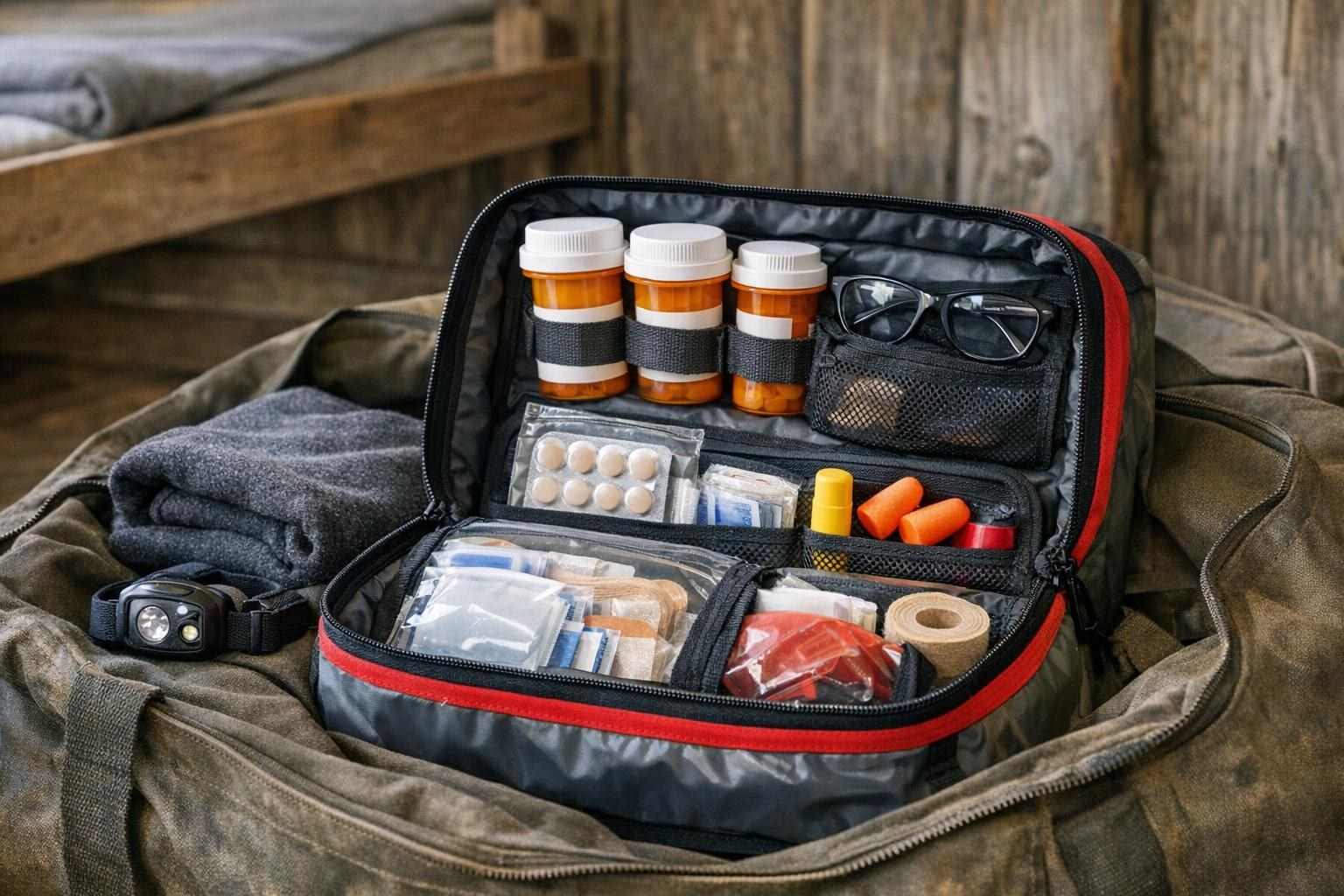
As with any travel, carry your personal medicines in your carry-on or in your day pack. Pack the original containers for personal medicines and bring a list of your medicines, your instructions for use, any relevant medical information, and any allergy information. Give a copy of this list and the information in it to someone you trust, such as a traveling companion or your guide. Do not assume that the information will be kept confidential, however.
When packing medicines for a hunting trip it is best to pack enough for the trip and then add a bit of extra in case of unexpected delays such as delayed flights, wet weather, illness, or unexpected extended stays at the lodge. However, the amount of extra to bring is dependent upon the specific medicine and the clinician's advice.
Remember, personal medicines for your hunting trip may consist of items that you only occasionally use. These might include items for occasional use, such as for an occasional cough or sore eye, like an inhaler or epinephrine, for motion-sickness, for migraine, or for a variety of skin problems. Pack these items carefully, and check the expiration date and packaging before you leave, as some medicines may degrade in damp conditions, and items in bottles may leak if broken in moist conditions.
Check the current rules for carrying prescription medicines between countries. There may also be information on this from the airline, border agency or government health website. Your prescribing doctor will also be able to tell you what documentation you may need to bring with you. Don't confuse this with the camp's first aid supplies and treat your own personal requirements separately.
Separate daily comfort from true camp necessities
What little comfort items will you need to feel rested and ready for your hunt? A sleep mask, earplugs, lip balm, moisturizer (scentless), an extra pair of glasses, blister protectors, a notebook and a small headlamp with spare batteries for example. A simple pillowcase or the base layer that you prefer to sleep in will suffice as a comfort item as well.
Remember to focus on the function of an item rather than the brand name. Although it may be appealing to bring many different varieties of cold weather gloves, one good pair that will dry out by night could be better than to carry several specialized ones. Blister prevention, a simple repair kit with needles and thread, and spare boot laces as well as a few sealable bags will solve more problems than bringing many large and bulky items.
Remember to consider that a lodge is a shared space with many people. Avoid packing scented products to use in the lodge. Similarly, avoid loud electronics, excessive packaging, and things that require re-charging for use in the lodge. Look for the simplest, most durable items to use in your comfort and personal care.
Prepare for Wet Gear, Poor Sleep, and Changing Weather.
Set aside the possibility that something may get wet. Medical, documents, electronics and your extra clothing should all be kept remote from your wet layers. Consider using waterproof bags and/or dry sacks to store these items. Small inner bags make the best liners as you can find what you need when the main bag is opened up for inspection in a dripping wet muddy campsite.
Anything you need for immediate use when you arrive at the remote location (as opposed to later in the evening) should be in a short access layer of your pack. This might include your medicines, your toiletries, an extra warm layer, clean socks for the next day, etc. Your immediate needs for the first evening at camp should be easily accessible from the top of your pack.
Sleeping in the lodge should be just as considerate of your comfort. In order to be at your best in the field, pack the sleep assist items as well as the clothing that you normally wear to bed. Note that some sleep aids, such as certain types of Prescription Medications or Supplements, are best to take under the direction of a qualified clinician, at home, before leaving for a hunt. Many conditions (altitude, cold, etc.) can cause decreased level of activity as well as decreased sleep. Plan accordingly.
Make the handoff easy for guides and camp staff
A good system for packing your personal items for a guided big game hunt helps your guides and camp staff to help you. Clearly label your bags, make a short list of your essential items and inform your guides of any special circumstances that may affect you during the day, such as food allergies, mobility problems, etc. Only share the information that is necessary for the guides to know in order to assist you and do so well in advance of your departure.
Try to remember that when you are planning for your big game hunting trip, a guided hunt is not improved by your being ill, tired or experiencing side effects from your medication. If, because of any of these things, you are unable to complete a days walk, cannot make a good judgment regarding hunting conditions or will not be able to make a clean shot then do not go. Pass up the opportunity for such a hunt and try again another time.
It is also important to confirm with your outfitter the most up to date travel information and any medical information required for your country of travel before you depart. Most importantly the preparation for a remote hunt is to create a system that will allow you to have the best possible hunt while maintaining your health and making good decisions in the face of adversity.